How will RFID technology be applied in concrete management?
2019-04-26 · With the rapid development of urban construction, the efficiency of the construction industry has led to an increasing demand for concrete. Concrete production management is more scientific and informatized. For enterprises, how to achieve automated operations management and efficient operations has become a crucial factor for the survival and rapid development of the enterprise. How will RFID technology be applied in concrete management at Shangtai?
With the rapid development of urban construction, the efficiency of the construction industry has led to an increasing demand for concrete. Concrete production management is more scientific and informatized. For enterprises, how to achieve automated operations management and efficient operations has become a crucial factor for the survival and rapid development of the enterprise. How will RFID technology be applied in concrete management at Shangtai?
As a traditional vehicle management method: the planning dispatcher formulates concrete production plans for the batching station based on the site's production plan and on-site feedback, arranging concrete transport vehicles for site transport; Schedulers should always understand the transportation status, routes, times, queues, and other complex information for each vehicle, which is closely related to their management experience and is prone to errors, which is not conducive to control. For example, using RFID RFID technology for vehicle management frees schedulers from complex information and reduces the likelihood of errors in vehicle scheduling; After each vehicle enters the batching plant, it automatically swipes cards to queue. Concrete production calls vehicles according to the fleet queue, and after leaving the station, vehicles swipe their cards again to record information such as the transport site, volume, and departure time; After vehicle transportation is completed, the vehicle returns to the mixing station and swipes the card again, repeating this cycle to reduce the impact of human instability in vehicle management.
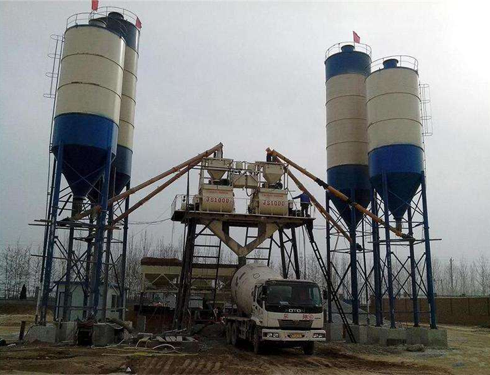
The vehicle management system is equipped at the plant entrances and exits with an RFID RFID card reader, two RFID antennas, and a detection indicator light. Each vehicle entering or exiting the plant is equipped with an onboard tag; Transport vehicles do not need to get out when entering or exiting the batching plant; they simply slow down and reach the RFID detection area. The recognition antenna will automatically detect the stored information on the onboard tag, transmit it to the card reader, and feed the information back to the vehicle management system via the local area network; The computer at the vehicle management and dispatch center in the batching station is connected to an RFID RFID card reader to obtain onboard tag information, facilitating access to concrete production and office personnel for management and calls; An LED display screen is installed above the parking area of the batching plant, showing the status of production call vehicles and vehicle queue information.
For the card reader connecting to the computer, two communication methods are provided: CAN bus and TCP/IP, each providing one RS232 port and one Ethernet port. As a communication network oriented toward industrial low-level control, CAN fieldbus offers outstanding reliability, real-time performance, and flexibility in data communication; This is mainly reflected in CAN operating in a multi-master mode, with nodes on the CAN bus divided into different priorities and using non-destructive arbitration technology. Messages use a short-frame structure, resulting in extremely low data error rates. Nodes can automatically shut down output in severe errors; However, its limitations are also obvious. First, it cannot be interconnected with the Internet and cannot share remote information. Second, it is not easy to interface directly with the upper-level controller, and existing CAN interface cards are generally more expensive than Ethernet network cards; Moreover, CAN fieldbus cannot compare to Ethernet in terms of communication distance or speed.
TCP/IP-based Ethernet is a standard open network with good system compatibility and interoperability, strong resource sharing capabilities, and easy sharing of control site data with resources on the information system. Data transmission distances are long, transmission rates are high, easy to connect to the Internet, low cost, easy to network, and interfaces with computers and servers are very convenient, receiving broad technical support.
Vehicle management, as an important part of daily production management at concrete batching plants, is subject to RFID technology automatic identification and collection of vehicle information. It plays a decisive role in the normal operation of the plant, and the quality of vehicle arrangements directly affects the production and operating costs of the plant.
Get a quote plan
Just state your usage scenario and we can provide you with a quote! Thank you for your cooperation!