
Gold Finger PI Polyimide Die-Cut Pads
Gold finger PI polyimide pads combine amber polyimide film, silicone pressure-sensitive adhesive and fluoroplastic release material and can be die-cut to drawings. They provide stable adhesion and conformability together with heat and solvent resistance, high electrical insulation, solder resistance, clean removal, wear resistance and tear resistance for PCB gold fingers and electronic processing.
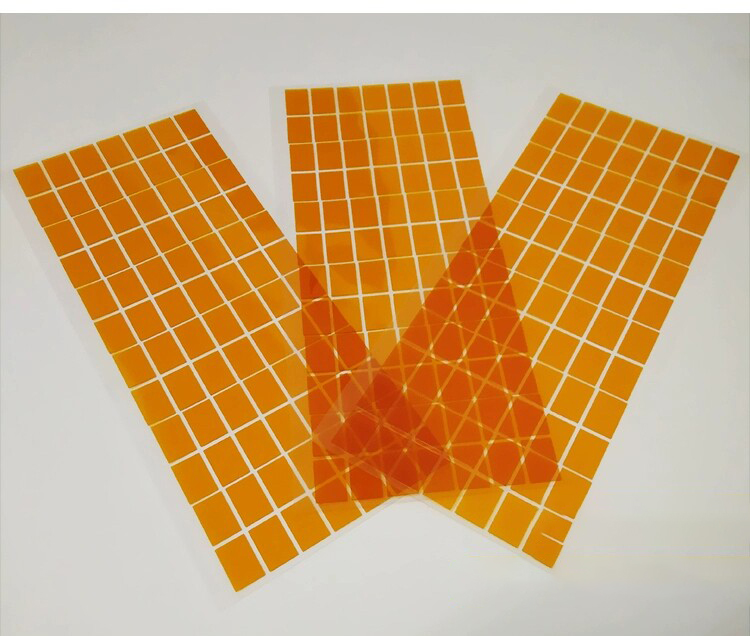
Product overview
Gold finger PI polyimide is an amber high-temperature die-cut adhesive pad made from polyimide film coated with silicone pressure-sensitive adhesive and supplied on fluoroplastic release material. It can be die-cut or punched to a customer's drawing, sample, dimensions and shape. The polyimide carrier maintains useful flexibility and dimensional stability in high-temperature electronic masking and insulation, while the silicone adhesive provides stable tack and conformability on PCB gold fingers, pads, board edges and local electronic-component areas. The product information describes heat and solvent resistance, resistance to solder penetration, clean removal with little adhesive residue, good mechanical performance, wear resistance, tear resistance, high insulation and low electrolysis. The standard linked product is marked for 160°C. Other images refer to 280–300°C performance and custom 300°C adhesive, so the actual working temperature must be confirmed according to adhesive grade, thickness, heating duration and production process, with high-temperature grades qualified by sample testing.
Product features
- Polyimide film with silicone pressure-sensitive adhesive and fluoroplastic release material, supplied in an amber colour for high-temperature electronics processing.
- Stable tack and good conformability help the pad follow gold fingers, solder pads, PCB edges and irregular electronic parts while reducing edge lift.
- The standard linked grade is marked 160°C; 280–300°C or custom 300°C adhesive grades can be evaluated for the required heat profile while retaining flexibility and reducing deformation.
- The information states resistance to solvents and corrosion, no dissolution in water and common solvents, and resistance to ageing and colour fading for demanding processing environments.
- High electrical insulation and low electrolysis support local circuit isolation and reduce unwanted electrical contact during high-temperature processing.
- During soldering, wave soldering and tin spraying it resists solder penetration; after processing it can be removed cleanly with little residue, reducing cleaning work.
- Good mechanical strength, wear resistance, tear resistance and creep resistance suit small squares, circles, strips, holes and other custom die-cut shapes.
- The supplied information identifies a non-toxic, odourless environmental material; food-contact or regulatory claims must be confirmed against the actual material certificate and order standard.
Applications
- Local masking of PCB gold fingers, connector terminals and solder pads during wave soldering, reflow soldering, tin spraying and high-temperature soldering.
- Temporary fixing, electrical isolation and protection of nearby components during SMT, electronic assembly and PCB repair.
- Heat-resistant insulating wraps, adhesive pads and die-cut parts for lithium batteries, transformers, motors, coils and electronic components.
- High-temperature paint, plating, soldering and process masking for precision electronics, metal parts and industrial components.
- Electronic manufacturing and repair processes requiring clean removal, solder resistance, low residue and stable adhesion.
- Custom square, round, strip, perforated or irregular PI pads for batch assembly, positioning and protection.
Procurement notes
For quotation, provide the process, bonding substrate, drawing or sample, dimensions, thickness, required adhesion, maximum temperature, heating duration, quantity, sheet layout, release format and packaging. The standard linked product is marked 160°C. If 280–300°C performance or a custom 300°C adhesive is required, specify the real temperature profile, dwell time, soldering or tin-spraying conditions so that the PI carrier, adhesive system and thickness can be matched. Dimensions, shapes and die-cut structures are customizable. Sample approval before mass production is recommended to verify adhesion, conformability, insulation, solder resistance, clean removal and residue. Store at 10–30°C and 40%–70% relative humidity, away from direct sunlight, temperatures above 40°C and humidity above 75% RH; reseal after opening to protect against dust and moisture.
Get a quote plan
Just state your usage scenario and we can provide you with a quote! Thank you for your cooperation!