
ID card manufacturing, ID card manufacturers, ID card production and design
ID card manufacturing, ID card manufacturers, ID card production and design
.jpg)
Main features of ID cards:
The carrier frequency is 125KHZ (THRC12) or 13.56MHz (THRC13); The data transmission to the card reader is modulated by loading amplitude modulation;
The in-card data encoding uses BPSK phase-shift keying with strong anti-interference capability;
The data transmission rate from card to reader is 3.9kbps (THRC12) or 6.62kbps (THRC13);
Data storage uses EEPROM, with data retention lasting over 10 years; The data storage capacity is 64 bits, including manufacturer, publisher, and user code;
Once the card number is written before sealing, it cannot be changed, ensuring absolute uniqueness and security;
In addition to being packaged in standard card shapes, THRC13 chips can also be packaged into various shapes such as chips according to application needs.
(1) How the ID card works:
The system consists of a card, a card reader, and a backend controller. The work process is as follows:
The card reader sends the carrier signal outward via the antenna;
After the card enters the reader's working area, a resonant circuit composed of inductive coils and capacitors receives the carrier signal sent by the card reader. The RF interface module of the chip generates the power voltage, reset signal, and system clock from these signals to "activate" the chip;
The chip read control module encodes the data in memory through phase modulation, modulates it onto the carrier, and sends it back to the card reader via the card's internal antenna;
The card reader demodulates and decodes the received card return signal and sends it to the backend computer; The backend computer handles and controls different applications based on the validity of the card number.
(2) Types of ID cards:
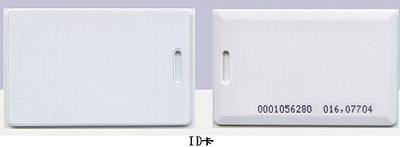
ID Thick Card: 1.8mm thick, the size of a standard card, currently the most economical RF IC card, comes with an ID number, a portable port, and can screen print logo text information; Standard thin card: 0.8mm thickness, size of standard card, can be offset, screen printing, or photo printing;
Non-standard thin card: thickness 1.05mm; standard cards can be offset, screen printing, or photo printing;
(3) Scope of ID Card Applications:
Compared to contactless IC cards, contactless ID cards do not require insertion or removal, avoiding various faults caused by poor mechanical contact. As a result, they offer advantages such as easy operation, speed, reliability, and long lifespan, making them especially suitable for high-traffic environments. Typical applications: Radio frequency identification fields such as cafeteria meal sales systems, patrol systems, attendance systems, access control systems, and enterprise all-in-one card systems. The THRC12/13 contactless ID card is mainly used for identity identification and addressing control, such as access control, security, attendance, and more. It can also be extended to public places like exhibitions, parks, hotels, restaurants, and other tickets, discount cards, and more. As well as logistics, electronic tags, anti-counterfeiting labels, one-time tickets, and other sectors such as production processes, postal parcels, air and rail transportation, product packaging, and transportation, among many other fields. Although it is only a card reader, it is managed by backend computers, allowing it to be applied to certain areas even when it involves billing management, such as cafeteria meal fee management. For specific applications, cardholders' personal information can be sent to the backend computer, a database is created, and application software is configured. When used, the card number is transmitted to the backend computer via a card reader, which retrieves the cardholder's personal information from the database and then operates according to the specific application, making its application scope extremely broad.
The process and craftsmanship of making ID cards
The process of making the ID card
1. Printing
2. Panel (insert the ID copper wire into the card)
3. Synthesis (combining the ID copper wire with the card)
4. Quality inspection (checking for damaged ID cards)
5. Push the Card
6. Special processes
7. Quality inspection
8. Packaging
9. Shipping
ID card manufacturing process
1. ID cards can be printed on either single-sided or double-sided printing, using screen printing or offset printing (CMYK four-color printing).
2. Each ID card can be sprayed with different numbers, PIN codes, or text.
3. The ID card can be marked with a signature slip or writing board (for areas where manual writing is allowed).
4. The ID card can be equipped with low-density or high-density magnetic strips (three-track magnetic stripes) according to customer requirements.
5. The ID card can be embossed, and the embossed code can be stamped with gold or silver.
6. You can punch round or strip holes on the ID card.
7. ID cards can be printed with various types of barcodes.
8. ID card numbers can be arranged sequentially, or personalized or irregular numbers can be used.
9. ID cards can be made into square, round, or any other irregular shape.
10. The background color of the ID card can be made to imitate gold or silver.

Get a quote plan
Just state your usage scenario and we can provide you with a quote! Thank you for your cooperation!